Coptis rhizome (Huang Lian)
Huang Lian
COPTIS RHIZOMA
Nature and flavorBitter, cold; enters Heart, Spleen, Stomach, Liver, Gallbladder and Large Intestine meridians.
Meridians enteredHeart, Spleen, Stomach, Liver, Gallbladder, Large Intestine
Dosage2–5 g; suitable amount for external use.
Reference market price¥320 / kgBozhou market · spec 单枝 · 四川 · snapshot 2026-11-21
Coptis rhizome is a bitter, cold herb used in traditional medicine to clear heat, dry dampness, and resolve toxicity.
Source药物来源
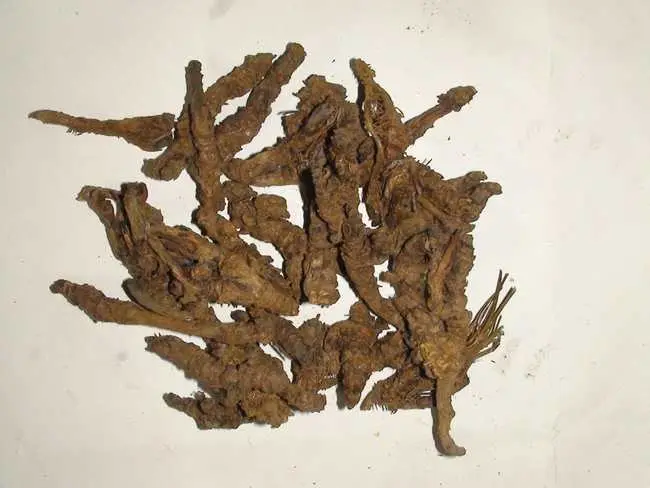
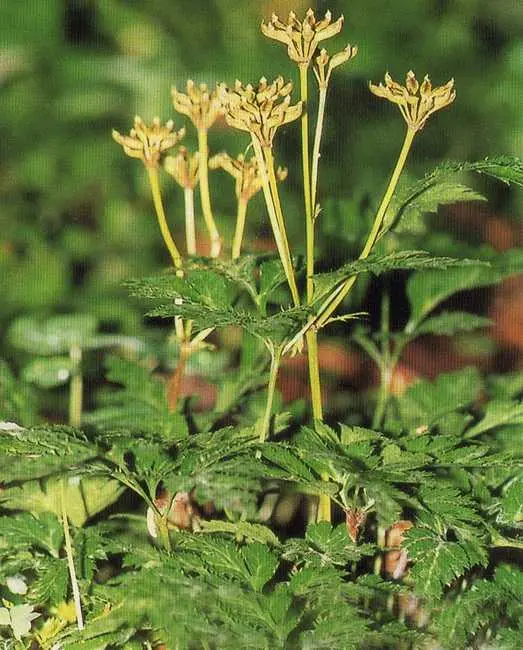
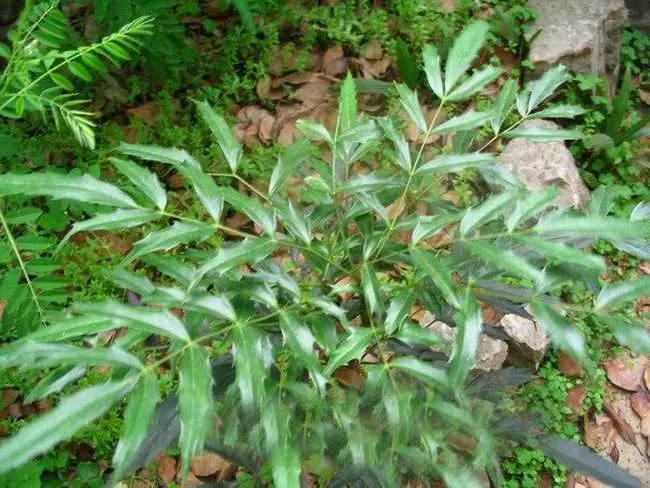
The dried rhizome of Coptis chinensis Franch., Coptis deltoidea C.Y.Cheng et Hsiao, or Coptis teeta Wall. (Ranunculaceae). Name origin: the medicinal root is used; “its root is bead-like and yellow, hence the name” (Bencao Gangmu). Because the rhizome is branched, often in clusters of 3–6, slightly curved and resembling eagle claws or chicken claws, it is also called “eagle-claw lian” or “chicken-claw lian”.
Identification性状特征
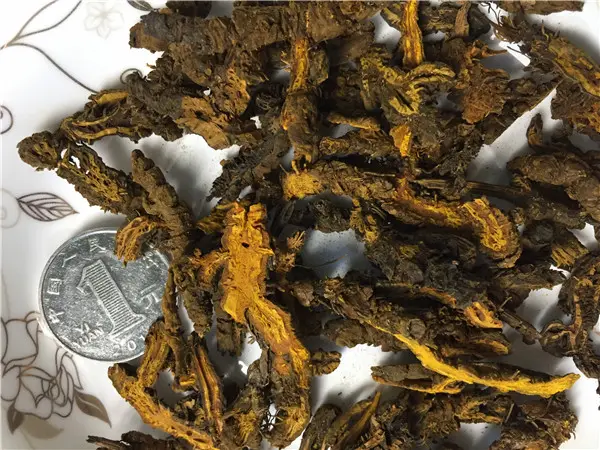
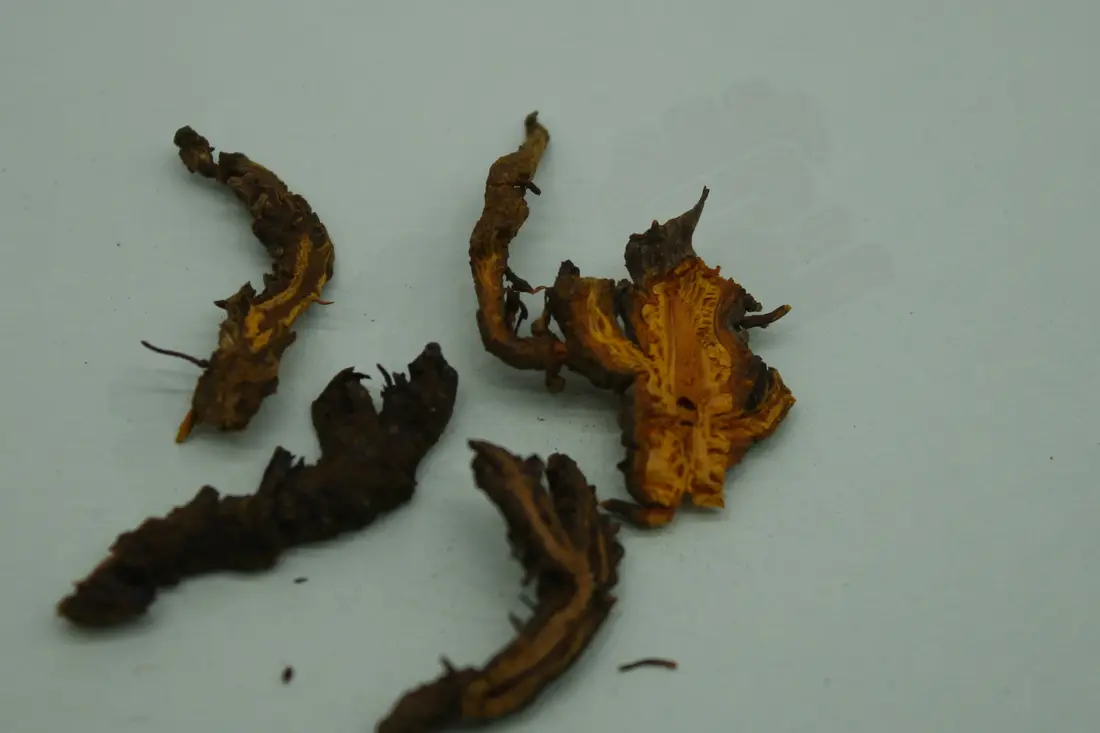
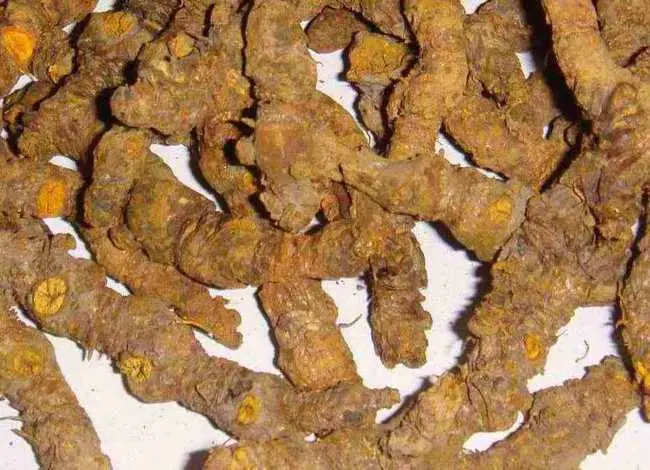
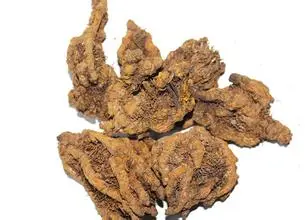
Wei Lian: usually clustered, curved like chicken claws; single rhizome 3–6 cm long, 0.3–0.8 cm diameter. Surface grayish-yellow or yellowish-brown, rough, with irregular nodular protrusions, fibrous roots and root remnants; some internodes smooth like stems, commonly called “bridge”. Upper part often with residual brown scale leaves, apex often with remnant stem or petiole. Hard; fracture uneven; cortex orange-red or dark brown; wood bright yellow or orange-yellow, radially arranged; pith sometimes hollow. Slight odor; taste extremely bitter. Ya Lian: mostly single, slightly cylindrical, slightly curved, 4–8 cm long, 0.5–1 cm diameter; “bridge” longer; apex with few residual stems. Yun Lian: curved hook-like, mostly single, smaller and finer.
Properties and actions性味与功效
ActionsClear heat and dry dampness · Resolve toxicity and reduce fire
IndicationsUsed for damp-heat distention and fullness, vomiting and acid regurgitation, diarrhea and dysentery, jaundice, high fever with impaired consciousness, exuberant heart fire, irritability and insomnia, palpitations, blood-heat vomiting and epistaxis, red eyes, toothache, wasting-thirst, carbuncles, swellings, boils and sores; externally for eczema, damp sores, and purulent ear discharge. Wine-processed Huang Lian is good at clearing upper-jiao fire; used for red eyes and mouth sores. Ginger-processed Huang Lian clears the stomach, harmonizes the stomach and stops vomiting; used for alternating cold and heat, damp-heat obstructing the middle, distention and vomiting. Evodia-processed Huang Lian soothes the liver, harmonizes the stomach and stops vomiting; used for disharmony of liver and stomach, vomiting and acid regurgitation.
Dosage2–5 g; suitable amount for external use.
CautionBitter and cold; use with caution in deficiency-cold of the spleen and stomach. Do not use long-term in large doses.
Processing炮制
Huang Lian (raw)Remove impurities, quickly wash, moisten thoroughly, slice thinly, dry in air; or crush when used.
Wine-processed Huang LianMix clean Huang Lian slices with a measured amount of yellow wine, moisten briefly until absorbed, then stir-fry over gentle heat until dry, remove and cool, sift out fragments. Use 12.5 kg yellow wine per 100 kg Huang Lian slices.
Ginger-processed Huang LianMix clean Huang Lian slices with ginger juice, moisten briefly until absorbed, then stir-fry over gentle heat until dry, remove and cool, sift out fragments. Use 12.5 kg fresh ginger per 100 kg Huang Lian slices (if using dried ginger, use 1/3 of the amount of fresh ginger).
Evodia-processed Huang LianDecoct Evodia rutaecarpa with water, collect the decoction, mix with clean Huang Lian slices, moisten briefly until absorbed, then stir-fry over gentle heat until nearly dry, remove and cool, sift out fragments. Use 10 kg Evodia per 100 kg Huang Lian slices.
Modern research现代药理
Anti-pathogenic microorganism effects(1) Antibacterial: berberine, the main component, has broad-spectrum antibacterial action. In vitro, Huang Lian inhibits various cocci and bacilli; berberine inhibits at low concentrations and kills at high concentrations; also inhibits dermatophytes in tube tests. (2) Antiviral: inhibits influenza A PR8 and 56-S8, FM1, influenza B VirusIec, influenza C Virus1233, and new viruses in chick embryo tests. (3) Antiprotozoal: inhibits amoeba, trypanosomes, Leishmania; kills leptospira in vitro; anti-trichomonas.
Anti-arrhythmic effectsBerberine prevents and treats experimental arrhythmias induced by calcium chloride, aconitine, barium chloride, epinephrine, electrical stimulation, and coronary ligation in animals, with clear dose-response; also effective against atrial fibrillation induced by calcium chloride-acetylcholine. Clinically effective for ventricular and atrial arrhythmias of various causes. Berberine has positive inotropic action, slows heart rate, prolongs diastole, dilates resistance and capacitance vessels, lowers blood pressure, reduces cardiac preload and afterload, and has some anti-heart-failure effect.
Inhibition of platelet aggregationHuang Lian inhibits platelet aggregation.
Hypoglycemic effectBerberine and Huang Lian decoction lower blood glucose by inhibiting gluconeogenesis and promoting glycolysis.
Effects on central nervous systemSmall doses of berberine excite the cerebral cortex in animals; large doses inhibit.
Classical records历代本草
Shennong Bencao Jing records it as bitter, cold, used for heat, eye pain, dysentery, and abdominal pain. Bencao Gangmu warns that it is greatly bitter and cold, should be stopped once the condition is resolved, and not taken long-term, as it may injure the spleen and stomach. It also notes that compatibility with cold and hot herbs balances its effects.《神农本草经》:味苦,寒。主治热气,目痛,眦伤,泣出,明目,肠澼,腹痛,下痢,妇人阴中肿痛。久服令人不忘。
《本草纲目》:黄连大苦大寒,用之降火燥湿,中病即当止。岂可久服,使肃杀之气常行,而伐其发生冲和之气乎?歧伯言:五味入胃,各归所喜攻。久而增气,物代之常也。气增而久,夭之由也。王冰注:酸入肝为温,苦入心为热,辛入肺为清,咸入肾为寒,甘入脾为至阴而四气兼之,皆增其味而益其气,故各从本脏之气为用。所以久服黄连、苦参反热,从火化也,余味皆然。久则脏气偏胜,即有偏绝,则有暴夭之道。是以绝粒服饵之人不暴亡者,无五味偏助也。况眼疾本于肝热,肝与心为子母,心火,肝亦火也,肾孤脏也,人患一水不胜二火,岂可久服苦药,使心有所偏胜,是以火救火,其可乎?
黄连,治目及痢为要药。古方治痢,香连丸(木香、黄连)。姜连散(干姜伍)。变通丸(茱萸伍)。姜黄散(生姜伍)。治消渴用酒蒸黄连。治下血,大蒜伍。治口疮,细辛伍。皆一冷一热,一阴一阳,寒因热用,热因寒用,君臣相佐,阴阳相济,最得利方之妙,所以有成功而无偏胜之害也。
去心窍恶血,解服药过剂烦闷。
权、斅、道书皆言黄连犯猪肉令人泄泻。
《本草蒙筌》:味苦,气寒。味厚气薄,可升可降。沉也,阴也,阴中微阳。无毒。治诸火邪,依各制炒。治诸火邪,依各制炒。火在上炒醇酒,火在下炒以童便。实火朴硝,虚火酽醋。痰火姜汁,伏火火伏下焦者。盐汤。气滞火同吴茱萸,血瘕火拌干漆末。食积泻亦可服,陈壁土向东者妙。研炒之。硝茱漆土俱研细,调水和炒。肝胆火盛欲驱,必求猪胆汁炒。又治赤眼,人乳浸蒸。或点或吞,立能劫痛。胜乌附,乌头、附子。畏款冬。恶芫菊芫花、菊花。玄参,忌猪肉冷水。为使黄芩龙骨,入手少阴心经。巴豆遇之,其毒即解。可熬膏煎液,任合散为丸。香连丸广木香和搀,为腹痛下痢要药;茱连丸吴茱萸佐助,乃吞吐酸水神方。如止消渴便多,单研蜜为丸亦效。同枳壳治血痔,血当归治眼疮。佐桂蜜煎服空心,黄连为君,佐官桂少许,煎百沸入蜜,空心服之。使心肾交于顷刻。镇肝凉血,凡治血,防风为上使,黄连为中使,地榆为下使。调胃厚肠。益胆止惊痫,泻心除痞满。去妇人阴户作肿,愈小儿食土成疳。消恶疮恶痈,却湿热郁热。
谟按:苦先入心,火必就燥。黄连苦燥,乃入心经。虽云泻心实,泻脾脏为子能令母实,实则泻其子也。但久服之,反从火化,愈觉发热,不知有寒。故其功效惟初病气实热盛者,服之最良,而久病气虚发热,服之又反助其火也。
《开宝本草》:味苦,微寒,无毒。五脏冷热,久下泄澼、脓血,止消渴,大惊,除水利骨,调胃,厚肠,益胆,疗口疮。
《名医别录》:微寒,无毒。主治五藏冷热,久下泄澼、脓血,止消渴、大惊,除水,利骨,调胃,厚肠,益胆,治口疮。
《本草图经》:黄连治目方多,而羊肝丸尤奇异。盖眼目之病,皆血脉凝滞使然,故以行血药合黄连治之。血得热则行,故乘热洗也。
《本草拾遗》:主羸瘦气急。
Folklore本草传说
The saying “good medicine tastes bitter” is often linked to Huang Lian, the bitterest of herbs. A well-known歇后语 says “a mute person eating Huang Lian cannot express the bitterness.” Historical physicians emphasized that Huang Lian should be used according to pattern; for example, Xiang Lian Wan (Huang Lian with Aucklandia) is for damp-heat dysentery, not for cold-dampness. Ye Tianshi’s mother was cured by adding Huang Lian to her prescription when her pulse was forceful, showing that even the elderly can use it if the pattern fits.
Cultivation and authentication栽培与鉴别
10 cultivation notes and 9 authentication articles exist for this herb. They are long-form field material and are published in Chinese only.
Read them in Chinese →