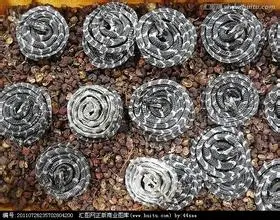
Bungarus Parvus (Jin Qian Bai Hua She)
Bungarus Parvus is the dried body of the young many-banded krait, a medicinal material used in traditional Chinese medicine.
This product is the dried body of the young snake of Bungarus multicinctus Blyth (family Elapidae).
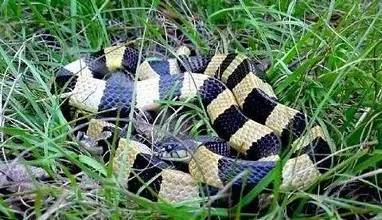
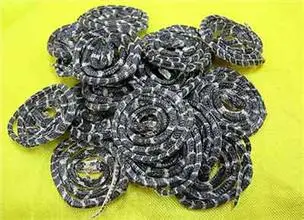
The product is coiled into a disc, 3–6 cm in diameter, with a body diameter of 0.2–0.4 cm. The head is coiled in the center, the tail is slender and often held in the mouth. The upper jaw bears a pair of venomous fangs at the front. There are 2 internasal scales, no loreal scales, and usually 7 upper and 7 lower labial scales on each side. The back is black or grayish-black with 45–58 white rings alternating with black. The white rings are 1–2 scale rows wide on the back and gradually widen toward the belly; the black rings are 3–5 scale rows wide. A distinct dorsal ridge is present, with enlarged hexagonal ridge scales. The dorsal scales are fine and dense, in 15 rows throughout; the subcaudal scales are in a single row. It has a slight fishy odor and a slightly salty taste.
Ancient texts such as the Classic of Mountains and Seas (Shan Hai Jing) record many strange snakes, including those with crests, horns, or multiple heads, and describe their appearances as omens. Later authors such as Tao Hongjing and Chen Zangqi discussed methods to reveal the feet of snakes. These legends reflect traditional beliefs about snakes.
0 cultivation notes and 6 authentication articles exist for this herb. They are long-form field material and are published in Chinese only.
Chinese version · All herbs