Abalone Shell (Shi Jue Ming)Materia Medica

Abalone Shell (Shi Jue Ming)

Shi Jue Ming
HALIOTIDIS CONCHA
Nature and flavorSalty, cold; enters the Liver meridian.
Meridians enteredLiver
Dosage6–20 g, decocted first.
Reference market price¥5 / kgBozhou market · spec 小 · 广东 · snapshot 2026-11-21

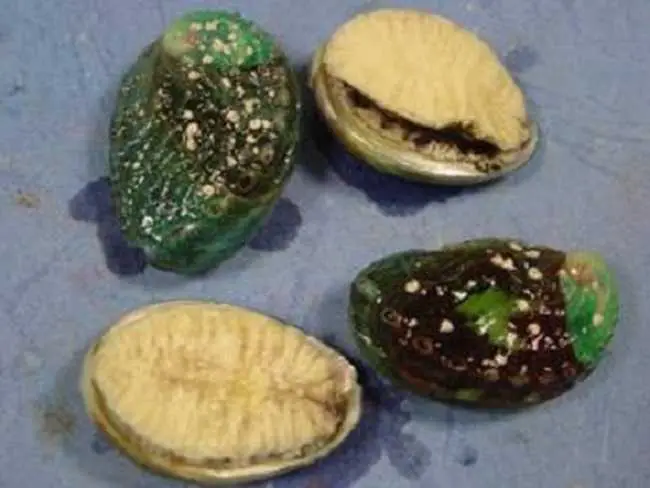
Abalone shell, known as Shi Jue Ming in Chinese medicine, is a mineral drug used to pacify liver yang and brighten the eyes.

Source药物来源

This product is the shell of the abalone species Haliotis diversicolor Reeve, Haliotis discus hannai Ino, Haliotis ovina Gmelin, Haliotis ruber (Leach), Haliotis asinina Linnaeus, or Haliotis laevigata (Donovan) (family Haliotidae).

Identification性状特征

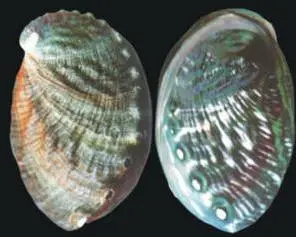
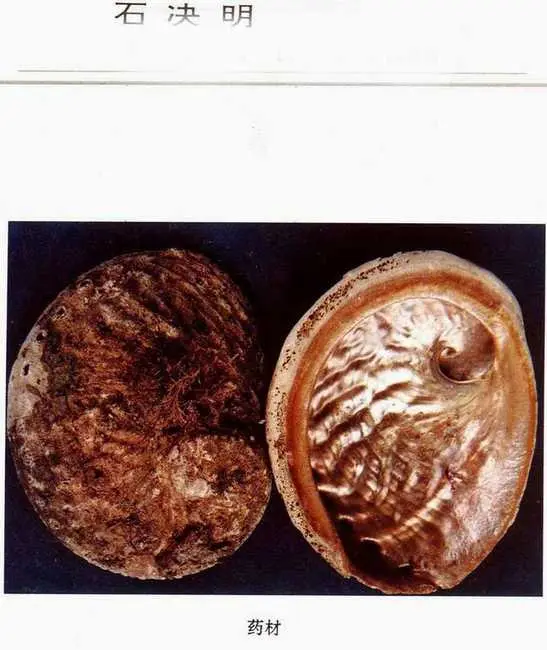
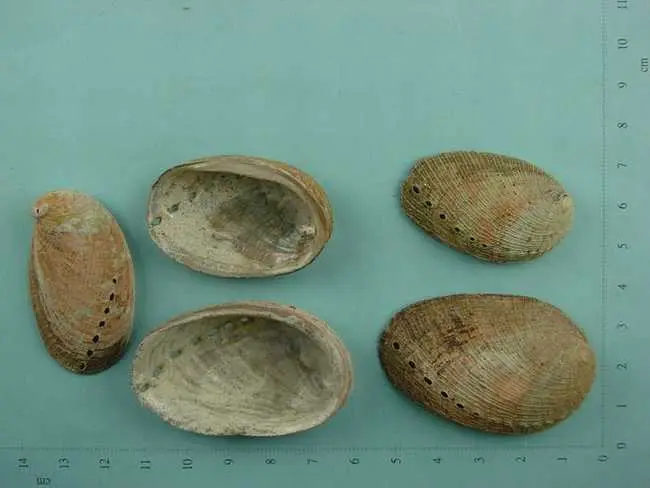
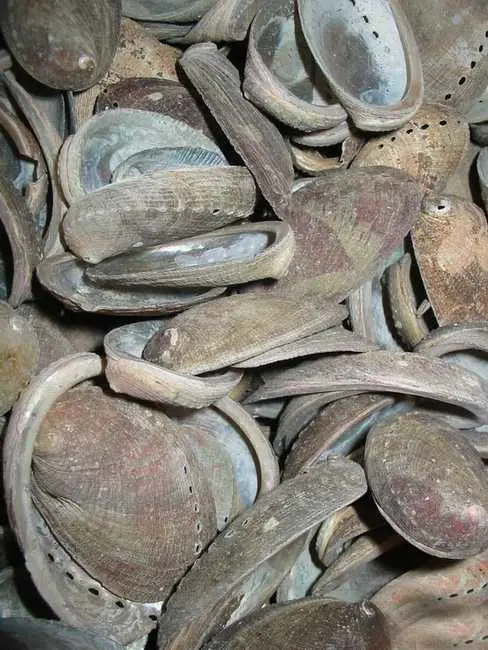
Haliotis diversicolor: Long oval, inner surface ear-shaped, length 7–9 cm, width 5–6 cm, height about 2 cm. Surface dark red, with many irregular spiral ribs and fine growth lines; spiral part small, body whorl large; about 20 tubercles arranged from the apex to the right, with 6–9 open holes at the end, hole openings flush with the shell surface. Inner surface smooth, with pearly iridescence. Shell thick, hard, not easily broken. Odorless; taste slightly salty. Haliotis discus hannai: Long elliptical, length 8–12 cm, width 6–8 cm, height 2–3 cm. Surface grayish-brown, with many rough irregular wrinkles, growth lines distinct, often with attachments such as moss or calcareous tubes; 4–5 open holes at the end, hole openings protruding above the shell surface; shell relatively thin. Haliotis ovina: Nearly round, length 4–8 cm, width 2.5–6 cm, height 0.8–2 cm. Apex near the center and higher than the shell surface; spiral part and body whorl each about 1/2; two rows of neat tubercles from the edge of the spiral part, more obvious in the upper part; 4–5 open holes at the end, tubular. Haliotis ruber: Flat oval, length 13–17 cm, width 11–14 cm, height 3.5–6 cm. Surface brick red; spiral part about 1/2 of the shell surface; spiral ribs and growth lines wavy and raised; more than 30 tubercles; 7–9 open holes at the end, hole openings protruding above the shell surface. Haliotis asinina: Narrow and long, slightly twisted, ear-shaped, length 5–8 cm, width 2.5–3.5 cm, height about 1 cm. Surface smooth, with patterns of emerald green, purple, and brown; spiral part small, body whorl large; 5–7 open holes at the end, hole openings flush with the shell, mostly elliptical; shell thin, relatively brittle. Haliotis laevigata: Oval, length 11–14 cm, width 8.5–11 cm, height 3–6.5 cm. Surface brick red, smooth; apex higher than the shell surface; growth lines quite distinct; spiral part about 1/3 of the shell surface; more than 30 tubercles; 9 open holes at the end, hole openings flush with the shell.
Properties and actions性味与功效
Actions
Pacify the liver and subdue yang · Clear liver heat and brighten the eyes
Indications
Used for headache and dizziness, red eyes with nebula, blurred vision, and night blindness.
Dosage
6–20 g, decocted first.
Caution
Contraindicated in deficiency-cold of the spleen and stomach; use with caution in yin deficiency with heat. (Derived from its cold nature.)
Processing炮制
Shi Jue Ming (raw)
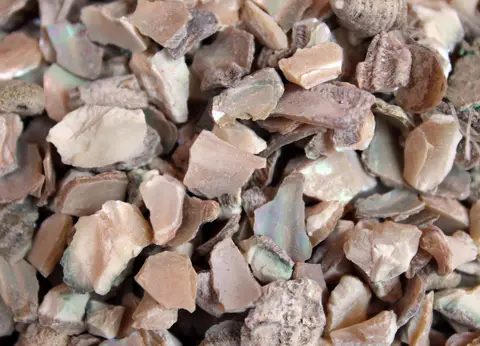
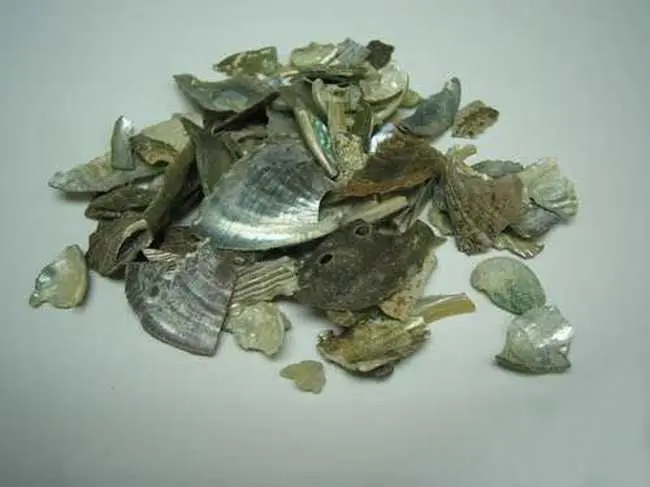
Wash the raw medicinal material, dry, and crush.
Calcined Shi Jue Ming
Place clean Shi Jue Ming on a smokeless fire or in a fire-resistant container, calcine with strong fire until ash-white or blue-gray and brittle, remove, cool, and crush. The calcined product reduces the salty-cold nature, moderates the liver-pacifying and yang-subduing effect, and enhances the astringent,收敛, and eye-brightening effects.
Modern research现代药理
Antibacterial effect
Shi Jue Ming has antibacterial action; its extract shows strong inhibitory effects against Staphylococcus aureus, Escherichia coli, and Pseudomonas aeruginosa.
Hepatoprotective effect
Shi Jue Ming has a protective effect against acute liver injury induced by carbon tetrachloride.
Anticoagulant effect
Shi Jue Ming has an anticoagulant effect.
Hypoxia tolerance
Shi Jue Ming can improve the hypoxia tolerance of mice under normal pressure.
Bronchodilator effect
Shi Jue Ming can increase the perfusion flow of isolated mouse lungs and dilate tracheal and bronchial smooth muscles.
Immunosuppressive effect
Shi Jue Ming has an immunosuppressive effect.
Gastric ulcer prevention
Shi Jue Ming has a preventive and therapeutic effect on gastric ulcers.
Classical records历代本草
The Bencao Gangmu notes that Shi Jue Ming is named for its ability to brighten the eyes (jue ming means 'brightening'), and that its use is to remove obstruction and restore clear vision. The Bencao Jing Shu explains that its salty-cold nature enters the blood to clear heat, thus treating various eye diseases, and that it also enters the kidney to supplement yin.
《本草纲目》:决明,千里光,以功名也。九孔螺,以形名也。 于目耳。是则石决明之用,不过拨芜累而发精光,乃目之曰镇肝清肺,其意何谓? 《开宝本草》:味咸,平,无毒。主目障翳痛,青盲。 《名医别录》:味咸,平,无毒。主治目障翳痛,青盲。 《海药本草》:主青盲内障,肝肺风热骨蒸劳极,并良。 《本草经疏》:石决明得水中之阴气以生,故其味咸,气应寒无毒。乃足厥阴经药也。足厥阴开窍于目,目得血两能视,血虚有热,则青盲赤痛障翳生焉,咸寒入血除热,所以能主诸目疾也。咸寒又能入肾补阴,故久服益精轻身也。研细水飞,主点外障翳。 《药性解》:味咸,性平,无毒,入肝经。主风热青盲内障、骨蒸劳热,久服益精。九孔、七孔者良。 按:石决明本水族也,宜足以生木而制阳光,故独入肝家,为眼科要药。命曰决明者,丹溪所谓以能而名也。
Culinary use民间药膳
Tianma Gouteng Yin
Gouteng (added later) 12 g, Chuan Niuxi 12 g, Shi Jue Ming 18 g (decocted first), Zhizi 9 g, Huangqi 9 g, Tianma 9 g, Duzhong 9 g, Yimucao 9 g, Sangjisheng 9 g, Yejiaoteng 9 g, Fushen 9 g.
Decoct the above herbs in water and take orally.
Pacifies the liver and extinguishes wind, clears heat and invigorates blood, and tonifies the liver and kidney. Used for headache or dizziness, insomnia, etc., caused by liver yang rising; may be selected for hypertension and acute cerebrovascular diseases with the above patterns.
Audio and video语音与视频
Narration · Chinese · 7:34
Latin name · pronunciation
Narration and video are shared by all language versions and are in Chinese; the images and footage themselves are language-independent.
Photographs药材图片
Abalone Shell (Shi Jue Ming)
Cultivation and authentication栽培与鉴别

0 cultivation notes and 2 authentication articles exist for this herb. They are long-form field material and are published in Chinese only.

Read them in Chinese →

Compiled from public Chinese materia medica sources for study and reference. Not medical advice.
Chinese version · All herbs