Gou TengMateria Medica

Gou Teng

Gou Teng
UNCARIAE RAMULUS CUM UNCIS
Nature and flavorSweet, cool; enters the Liver and Pericardium meridians.
Meridians enteredLiver, Pericardium
Dosage3–12 g, added near the end of decoction.
Reference market price¥30 / kgBozhou market · spec common grade · 陕西 · snapshot 2026-11-21

Gou Teng is a key herb in traditional Chinese medicine for calming the liver, extinguishing wind, and clearing heat.

Source药物来源

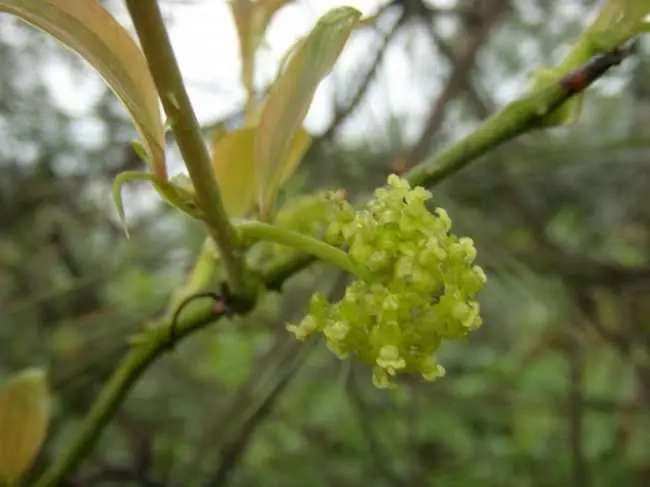
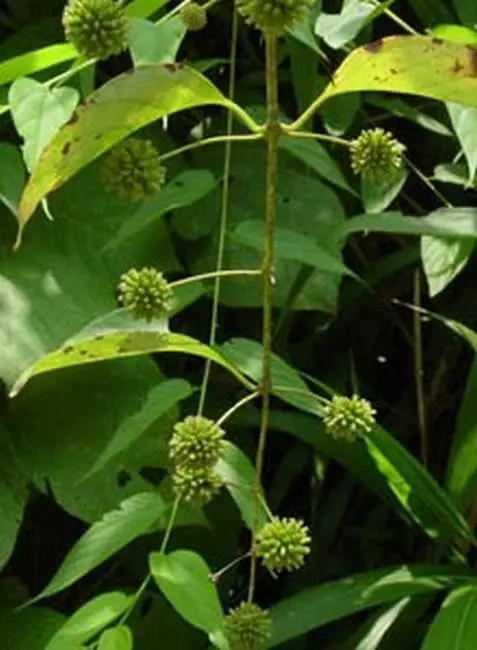
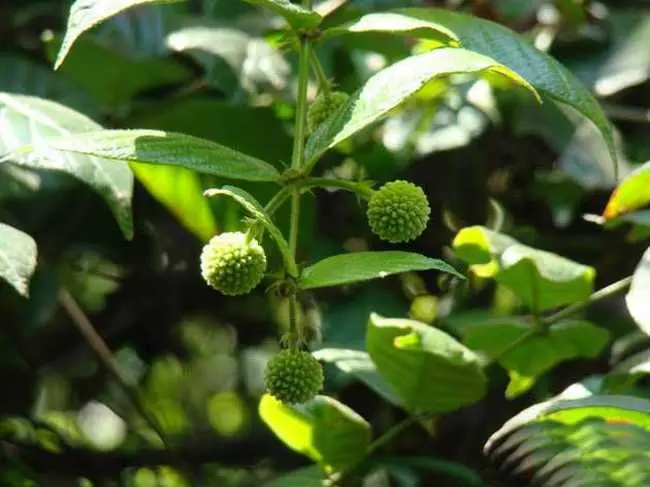
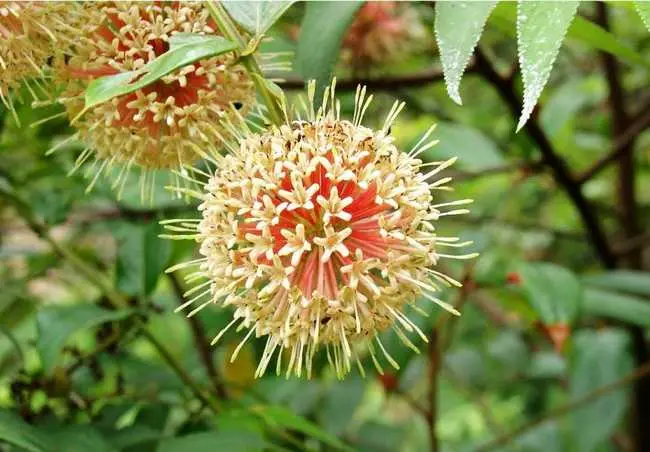
The dried stem branches with hooks of Uncaria rhynchophylla (Miq.) Miq. ex Havil., Uncaria macrophylla Wall., Uncaria hirsuta Havil., Uncaria sinensis (Oliv.) Havil., or Uncaria sessilifructus Roxb. (family Rubiaceae).

Identification性状特征

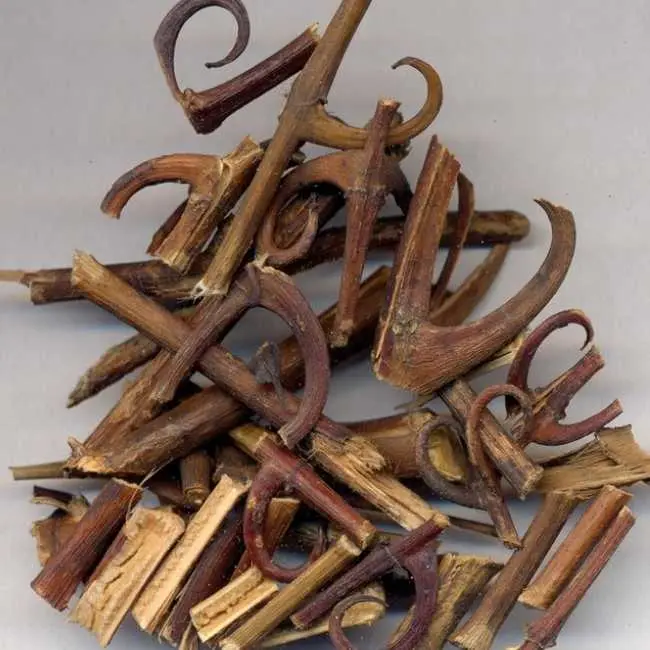
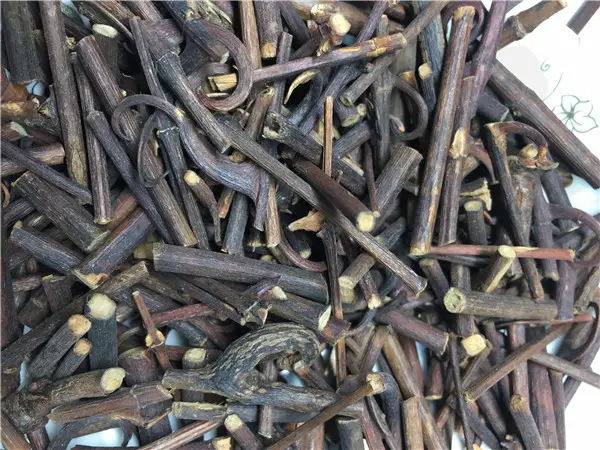
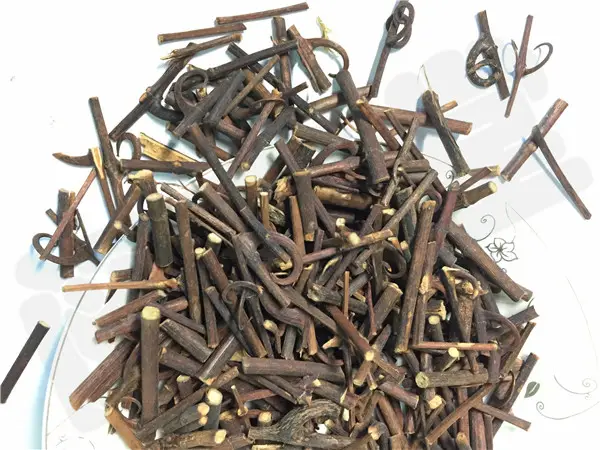
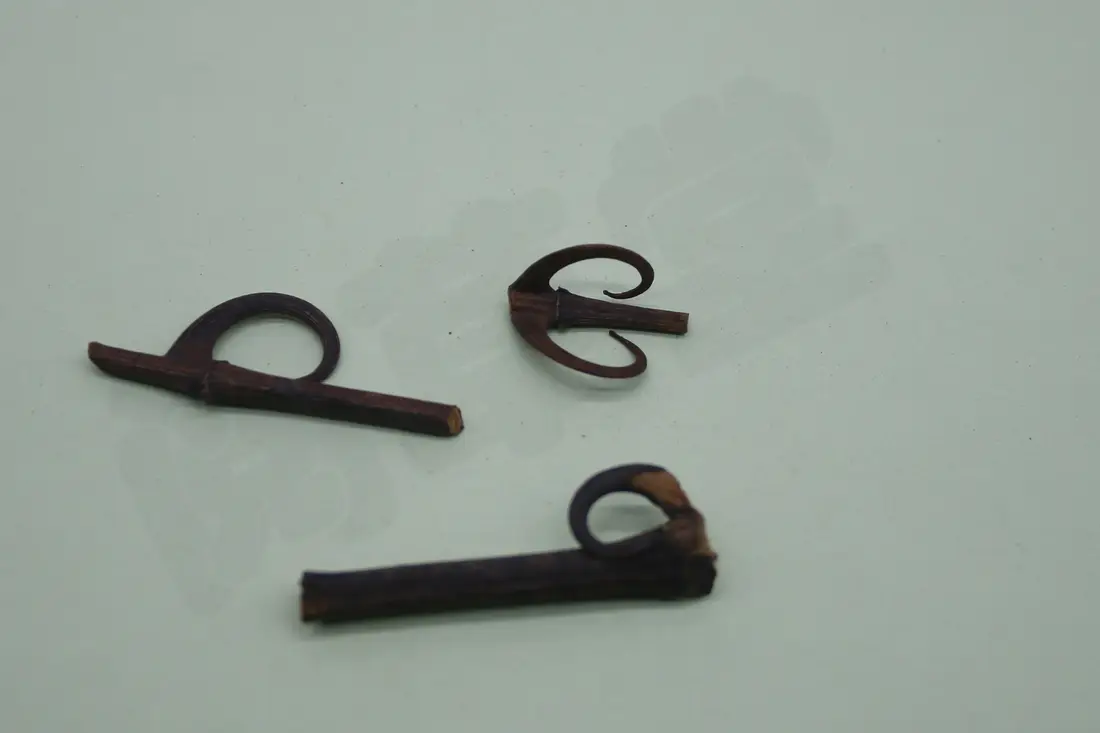
Stem branches are cylindrical or subquadrangular, 2–3 cm long, 0.2–0.5 cm in diameter. Surface red-brown to purple-red with fine longitudinal striations, smooth and hairless; or yellow-green to gray-brown with white dotted lenticels and yellow-brown pubescence. Most nodes bear two downward-curved hooks (sterile inflorescence stalks) opposite each other, or one hook with a scar on the opposite side. Hooks slightly flattened or rounded, apex fine and pointed, base broader; on the branch at the base of the hook, depression-like traces of fallen petioles and annular stipular scars are visible. Texture tough; fracture yellow-brown, cortex fibrous, pith yellow-white or hollow. Odor slight, taste weak.

Properties and actions性味与功效
Actions
Extinguish wind and stop tremors · Clear heat and pacify the liver
Indications
Used for internal movement of liver wind, convulsions and epilepsy, high fever with convulsions, common cold with fright, infantile night crying, gestational eclampsia, headache and dizziness.
Dosage
3–12 g, added near the end of decoction.
Caution
Use with caution in cases of spleen and stomach deficiency-cold; not suitable for long-term use without professional guidance.
Processing炮制
Raw
Remove impurities.
Modern research现代药理
Blood pressure lowering effect
Gou Teng has a hypotensive effect. Rhynchophylline can inhibit the vasomotor center, directly and indirectly dilate peripheral vessels, block sympathetic nerves and ganglia, and inhibit the release of neurotransmitters from nerve endings.
Sedative and anticonvulsant effects
Gou Teng has sedative and anticonvulsant effects.
Effect on smooth muscle
Gou Teng can relax intestinal, bronchial, and uterine smooth muscle, antagonize histamine-induced contraction, but its antagonism of acetylcholine is weak and it cannot antagonize spasms induced by nicotine and 5-HT.
Effect on isolated uterus and respiration
Rhynchophylline inhibits oxytocin- and high K+-depolarization-induced Ca2+ contraction of isolated rat uterus, and can inhibit respiration and constrict pupils in frogs and mice.
Anti-asthmatic effect
Total alkaloids of Gou Teng can inhibit histamine-induced asthma in guinea pigs.
Classical records历代本草
Li Shizhen's Bencao Gangmu states that Gou Teng enters the hand and foot jueyin meridians, treating wind and fire of the liver and pericardium. Other texts such as Bencao Mengquan and Bencao Jingshu also emphasize its use for pediatric convulsions and liver wind.
《本草纲目》:钩藤,手足厥阴经药。足厥阴主风,手厥阴主火。惊痫眩运,皆肝风相火之病。钩藤,通心包于肝木,风静火息,则诸证自除。或云:入数寸于小麦中蒸熟,喂马易肥。 大人头旋目眩,平肝风,除心热,小儿内钓腹痛,发斑疹。 状如蒲萄藤而有钩,紫色。古方多用皮,后世多用钩,取其力锐尔。 《本草蒙筌》:味甘、苦,气微寒。无毒。因类钩钓,故名钩藤。专医稚幼,不理别科。寒热惊痫,手足瘛疭者急觅,胎风客忤,口眼抽搐者宜求。 《本草经疏》:钩藤禀春气以生,《本经》气微寒,无毒。保升言苦。甄权言甘平。应是甘苦俱不甚,气味悉和平者也。为手少阴、足厥阴经要药。少阴主火,厥阴主风,风火相搏,则为寒热惊痫。此药气味甘寒,直气二经,则风静火息而肝心宁,寒热惊痫自除矣。甄权主小儿惊啼,瘛疭热壅,客忤胎风者,亦此意耳。 《名医别录》:微寒,无毒。主小儿寒热,十二惊痫。 《景岳全书》:味微甘微苦,性微寒。能清手厥阴之火,足厥阴、足少阳之风热,故专理肝风相火之病。凡大人小儿惊痫眩运、斑疹天钓、头旋烦热等证,用之而风静火息,则诸证自除矣。
Folklore本草传说

Gou Teng was recorded later in medicinal literature, first appearing in Tao Hongjing's Mingyi Bielu (Supplement to the Classic of Materia Medica) from the Southern and Northern Dynasties. Li Shizhen noted its use for pediatric formulas. Ge Hong of the Jin dynasty said it was often used in pediatric prescriptions. In the Song dynasty, Zhong Yang, a pediatric specialist, said: 'Gou Teng is treasured in pediatrics; its nature is swift and effective, dispelling wind-phlegm, opening qi blockages, and calming fright epilepsy in emergencies.' Modern physician Zhang Shanlei said: 'Gou Teng is light and clear in qi, sweet and cool in flavor, most suitable for young children whose yin is not yet full and yang is easily exuberant.' Gu Songyuan also said: 'Gou Teng dispels liver wind without dryness, treasured in pediatrics for treating cold-heat, fright, and crying.' Later generations used it in adults to pacify the liver and lower blood pressure, often in large doses. Ni Zhumo of the Ming dynasty in Bencao Huiyan said: 'Gou Teng loses its power with prolonged decoction; add it after other herbs have been boiled for about ten minutes for best effect.' Thus prescriptions often note 'add near the end'. In Chapter 84 of Dream of the Red Chamber, Xia Jingui, wife of Xue Pan, caused liver qi rebellion and left rib pain due to anger; Bao Chai quickly had Gou Teng decocted and gave it to her mother, and the pain gradually subsided after sleep.
Culinary use民间药膳
Gou Teng and Chrysanthemum Tea
Gou Teng 18 g, chrysanthemum 36 g.
Wash Gou Teng and chrysanthemum, brew with boiling water.
Pacifies the liver and extinguishes wind. Used for dizziness due to hypertension.
Watermelon Peel and Gou Teng Tea
Watermelon peel 30 g, Gou Teng 30 g.
Wash watermelon peel and Gou Teng, put in a pot, add water, decoct and take the liquid.
Clears heat and relieves summerheat, promotes urination, lowers blood pressure. Used for hypertension.
Cassia Seed, Chrysanthemum and Gou Teng Porridge
Cassia seed 15 g, white chrysanthemum 10 g, Gou Teng 10 g, rice 100 g, rock sugar to taste.
First stir-fry cassia seed until slightly fragrant, then decoct with chrysanthemum and Gou Teng to obtain liquid. Cook the liquid with rice into porridge, add rock sugar and simmer briefly.
Used for patients with hypertension and stroke.
Tianma and Gou Teng Drink
Gou Teng (added near end) 12 g, Achyranthes root 12 g, abalone shell 18 g (decocted first), gardenia 9 g, astragalus 9 g, gastrodia 9 g, eucommia 9 g, motherwort 9 g, mulberry mistletoe 9 g, fleeceflower stem 9 g, poria with hostwood 9 g.
Decoct the above herbs in water and take orally.
Pacifies the liver and extinguishes wind, clears heat and invigorates blood, tonifies liver and kidney. Treats headache or dizziness, insomnia due to liver yang hyperactivity; may be used for hypertension and acute cerebrovascular disease with the above patterns.
Audio and video语音与视频
Narration · Chinese · 7:34
Latin name · pronunciation
Narration and video are shared by all language versions and are in Chinese; the images and footage themselves are language-independent.
Photographs药材图片
Gou Teng
Gou Teng
Gou Teng
Gou Teng
Gou Teng
Gou Teng
Gou Teng
Gou Teng
Cultivation and authentication栽培与鉴别

2 cultivation notes and 7 authentication articles exist for this herb. They are long-form field material and are published in Chinese only.

Read them in Chinese →

Compiled from public Chinese materia medica sources for study and reference. Not medical advice.
Chinese version · All herbs